Workforce intelligence · Perspectives
Workforce analytics in the AI age: From reports to shared understanding
AI makes workforce questions easier to ask. Turning the answers into decisions everyone can trust takes more than a good model.
On this page
A workforce leader asks a straightforward question: Are we hiring the right people? Recruiting has source and conversion data. HR has employee records and retention history. Managers have performance reviews. Finance knows the budget. Each team holds part of the answer, yet agreeing on what a successful hire looks like takes more than bringing their spreadsheets together.
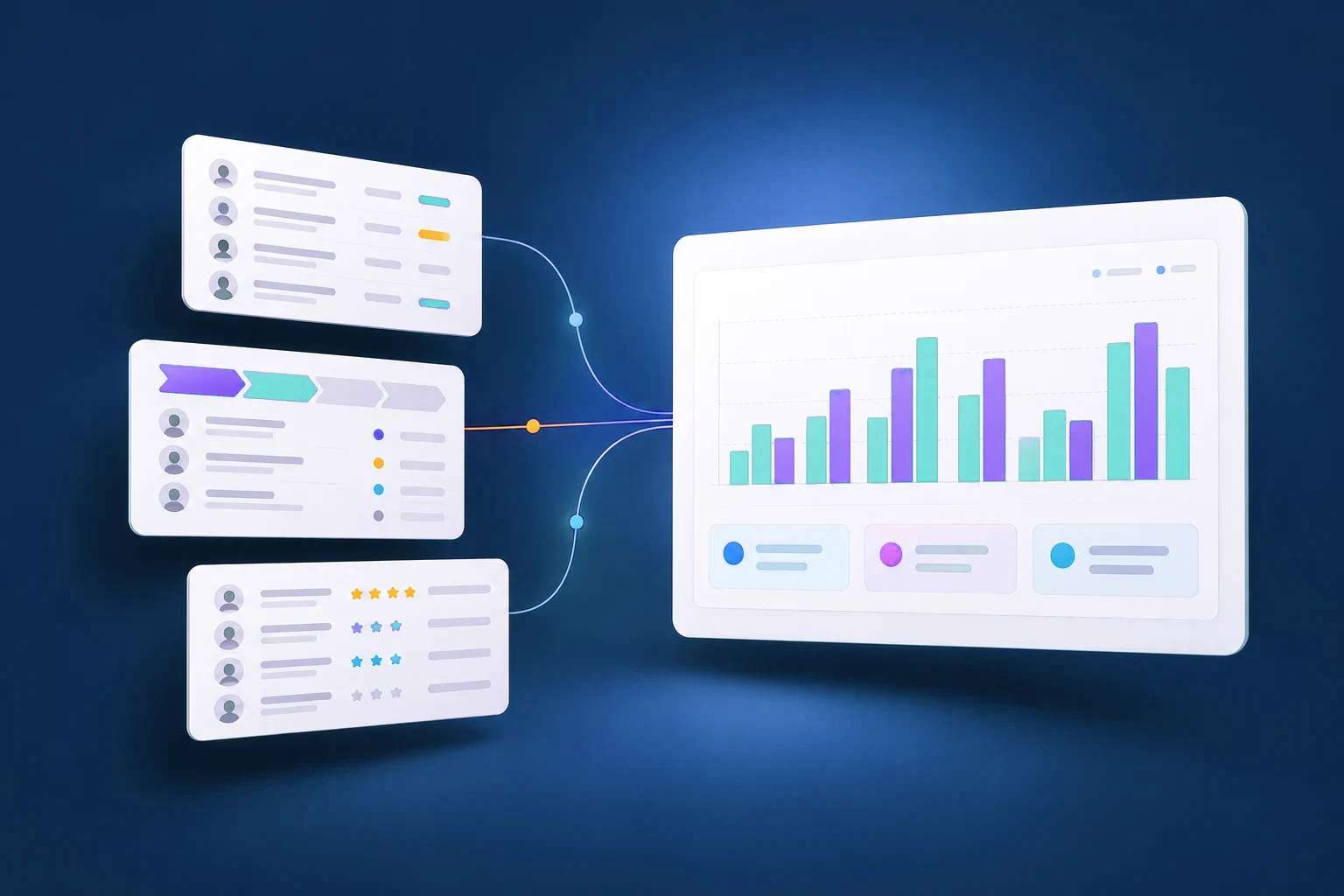
AI makes it easier to explore those questions in everyday language. The larger opportunity is to give people a common basis for making decisions: consistent definitions, visible evidence, and an understanding of what remains uncertain. That is the shift from producing reports to building shared understanding.
- HCM
- ATS
- And more
Connected data + shared definitions
One workforce picture
Clearer questions. Consistent meaning. Better-informed decisions.
The reporting bottleneck was never just about reports
In a familiar reporting workflow, a stakeholder requests an analysis, an analyst joins several datasets, and the team reconciles the figures before discussing the result. Every follow-up question starts another round. That cost can narrow the conversation to metrics already on a dashboard, even when the business needs a different view.
Research shows why AI is attracting attention. A 2025 study of 5,172 customer-support agents found that access to an AI assistant increased issues resolved per hour by 15% on average, with larger gains among less experienced workers. It studied one company and one occupation; it does not establish a comparable gain for workforce analytics. The variation matters as much as the average. See Generative AI at Work.
For workforce leaders, the useful ambition is shorter distance between a question and a well-supported decision. A conversation with data should help people investigate a result, compare explanations, and identify what to check next.
Make organizational context explicit
Consider workforce cost. Finance may mean actual spending, while a hiring manager means the budget needed to fill approved roles. Base salary, benefits, bonuses, contractors, and vacancies belong in different calculations depending on the question. An AI cannot resolve those choices reliably if the organization has never made them explicit.
A useful starting point is a short definition for each decision-critical metric:
- Population: who counts, including how contractors and employees on leave are treated.
- Period: a snapshot, a monthly average, or a cohort followed over time.
- Calculation: the numerator, denominator, exclusions, and units.
- Source and ownership: where the data comes from, when it was refreshed, and who resolves discrepancies.
These choices need to travel with the answer. A workforce size figure should distinguish headcount from full-time equivalents. A trend spanning a reorganization should state whether it uses historical reporting lines or today’s structure. Otherwise, a change in classification can look like a change in the workforce.
Shared definitions also need maintenance. Give each one an owner and preserve its history when it changes, so a new calculation does not quietly rewrite the meaning of last quarter’s decisions.
Follow one hiring question through the evidence
Start with a consistent observation window. For twelve-month retention, include hires whose first anniversary has passed and check whether each was employed at that point. Comparing recent hires with people observed for a full year would distort the result. Then compare similar roles, locations, and hiring periods; a source used mainly for senior specialists serves a different population from one used for seasonal hiring.
Next, examine performance separately. Agree on a review window and show how many hires have a rating. Missing reviews are unknown outcomes, not poor performance. If only employees who stayed received reviews, say so: the ratings describe survivors rather than everyone hired. Keep group sizes visible alongside percentages.
Even a persistent difference is an association. Manager support, pay, or onboarding could help explain it. As the CIPD’s people analytics guidance emphasizes, predictive relationships do not establish causation. The next step might be a limited sourcing pilot with agreed measures, alongside conversations with hiring managers, before committing the full budget.
Turn individual answers into shared understanding
Different functions bring different questions. Recruiting cares about pipeline, Finance about spending, and business leaders about capacity. A useful workforce conversation makes those perspectives visible while keeping comparable measures consistent.
There is early evidence that AI can help bridge functional perspectives. In a field experiment at Procter & Gamble, people using AI on product-innovation tasks produced proposals that combined technical and commercial perspectives more evenly. Individuals with AI also matched the quality of two-person teams without it. The study concerned short workshops at one company, so it does not demonstrate lasting organizational alignment. See The Cybernetic Teammate.
Our practical takeaway is to make an analysis reusable. Share the question, the population and period, the finding, and the assumptions behind it. Distinguish what the data shows from the team’s interpretation. Record the chosen action, its owner, and when the outcome will be reviewed. The next conversation can then build on the same evidence, including any unresolved disagreement.
Build trust into the way answers are used
A fluent explanation can still be wrong. NIST’s Generative AI Profile identifies confidently false outputs, privacy risks, and excessive reliance on AI as concerns organizations need to manage. For workforce analytics, that means making answers inspectable: show the supporting data, calculation, refresh date, and known gaps so a reviewer can check the result independently.
Access should follow the user’s permissions through every follow-up question and shared output. Aggregation alone is not enough when a small group makes someone identifiable. Set rules for sensitive fields and small groups, and explain to employees how their information is used.
Keep human accountability explicit. A pattern can prompt investigation; it should not become an automatic verdict about an employee. Reviewers need the authority to question an answer, correct its inputs, and stop a proposed action when the evidence is weak.
Start with one decision worth improving
Begin with a recurring question that already brings functions together: where to focus recruiting, how to support new hires, or which capacity gaps need attention. Keep the first scope small enough to verify with people who know the underlying records.
- Agree on the decision. Name the owner, the available choices, and what evidence would change the team’s view.
- Define and check the measures. Reconcile a sample against source records, document exclusions, and surface missing data before interpreting patterns.
- Challenge the answer together. Ask HR, Finance, and a business leader to review the same analysis. Resolve conflicting assumptions or record why they remain unresolved.
- Review what happened. Track time spent reconciling numbers, whether the analysis informed an action, and the outcome of that action over an agreed period.
This gives workforce analytics a clearer purpose. Analysts can spend more time testing explanations and helping leaders weigh tradeoffs. Leaders gain an evidence base they can question, share, and revisit. The lasting value is an organization that understands its workforce well enough to act thoughtfully and learn from what happens next.